
Bhutan or the “Land of the Peaceful Dragon” is a country of sprawling forests, venerated monasteries, and overpowering fortresses; lush green valleys fed by bountiful rivers and age-old practices. Cultivated fields surrounded by pitched roof houses with their typical trefoil-shape windows and Dzongs (fortresses) dominate the scenery with their sheer size. Its people are hardworking, vibrantly attired, and deeply religious while the land is immaculate. Bhutan's alpine pastures, peaks, forests, lakes, and flowers make it a paradise. Maybe that is why the rare black-necked crane makes its way across the Himalayas to Bhutan every year.
On arriving at the Paro International Airport, our representative will receive and escort you to the hotel in Thimphu, the capital city of Bhutan. The drive takes you through the winding road with multiple beautiful hamlets. Later evening, visit TashichhoDzong. TashichhoDzong: Located on the northern edge of the city of Thimphu, on the western bank of the Wang Chu. TashichhoDzong is Bhutan's most stately and arguably the most impressive building. It has traditionally been the seat of the Druk desi or ‘Dharma Raja’, the head of Bhutan's civil government, an office which has been combined with the kingship since the creation of the monarchy in 1907, and the summer capital of the country. It houses the throne room of His Majesty the King of Bhutan and is the summer residence of the venerated monastic community. The current dzong is the impressive result of a redesign of the original medieval structure sanctioned by the Third King, His Majesty King Jigme Dorji Wangchuk when he moved the capital to Thimpu from Punakha. The Fortress of the glorious religion houses the throne room of His Majesty the King, the main secretariat building, and the central monk body. Its courtyard is open to visitors during the Thimphu Tshechu and when the monk moves to its winter residence in Punakha.
Visit Memorial Chorten, Folk heritage museum, National Library of Bhutan & Institute of TraditionalMedicine.
The Memorial Chorten, also known as the Thimphu Chorten, is a large Tobetan-style Buddhist Monastery, a popular landmark in the city with its golden spires and bells. It was built in 1974 to honor the memory of the third king, Jigme Dorji Wangchuck. The architecture of the chorten has been designed to present it as ‘one of the most visible religious structures in Thimphu’.
The whitewashed chorten is decorated with richly carved annexes facing the cardinal directions and features elaborate mandalas, statues, and a shrine dedicated to the popular third king. There are numerous religious paintings and complex tantric statues housed inside reflecting both peaceful and wrathful aspects of Buddhist deities. This chorten is unlike other chortens as it does not enshrine the mortal remains of the King. Only the King’s photo in a ceremonial dress adorns a hall on the ground floor. The King when he was alive wanted to build a chorten to represent the mind of the Buddha’.
A three-storied traditional building houses the Folk Heritage Museum. Established in 2001 in Thimphu, the museum provides a glimpse into the traditional Bhutanese material culture and way of life. The artifacts, which are kept inside the house, remind the visitors about how the rural Bhutanese live today. This 19th-century traditional house provides you with a glimpse of the Bhutanese lifestyle and artifacts from rural households. One can come across typical household objects, tools, and equipment. .
The National Library of Bhutan was first established in 1967 under the patronage of HM Queen AshiPhuntsoChoden (1911–2003), with a small collection of precious texts. The library was initially housed within the central tower (utse) of Tashichodzong. Later, due to its growing collection, it had to move to a building in the Changgangkha area of Thimphu.
To provide a permanent home for the sacred religious books and manuscripts in the growing collection, construction of the present four-storeyed eight-cornered traditional building, which looks like the central tower temple of a Bhutanese Dzong, in the Kawajangtsa area of Thimphu was initiated. The cost of the construction of this building was borne entirely by the Royal Government of Bhutan without any foreign aid. It was inaugurated on November 23, 1984.
The National Institute of Traditional Medicine was established in 1988 with the concept of merging the allopathic and traditional systems of healing. It contains an impressive, large laboratory and production facilities that ensurethe quality of the products, the components of which include plants, minerals, animal parts, precious metals, and gems. The Institution produces traditional Bhutanese medicine towards the needs of the public. There is a day-care facility and clinic where doctors diagnose patients and prescribe appropriate medicines or treatments. The institute also researches the use of herbs and plants and has a plot on the premises. A small museum and a gift shop (where the famous herbal tea -Tsheringma- is produced) are also present in its compounds. There is also a training school for traditional medicine practitioners. After the closing of the Institute, visitors can walk along the compound to view it from the outside.
After an early breakfast, drive to Gangtey, 147 kms from Thimpu.Gangtey is a beautiful site situated at an altitude of 3000m. From Gangtey, one can closely view the picturesque black mountain ranges as well as the beautiful Phobjikha valley which is one of the biggest and the most beautiful valleys in the country. Upon reaching Gangtey, visit Gangtey Monastery, the largest Nyingma Monastery in Bhutan. It was built in 1613 AD. It is a very scenic and mind-soothing simple hike that would provide you with rewarding surprises. The Phobjikha Valley is famous for the endangered Black neck cranes that migrate here during the winters. Later walk around the Phobjikha valley, the valley is a huge glacial valley scattered with villages.
Morning, visit the Black Necked Crane Information Centre located on the edge of the forest and wetland along the main road of Phobjikha Valley. It has an observation room equipped with a high-power telescope and spotting scopes for catching the best view of the cranes. The center also offers display information that outlines the natural and cultural history of the area. There is a small gift shop, which sells handicrafts produced by the local people that local people can benefit from ecotourism. Later in the afternoon,hike theGangtey Natural Trail. (Gangtey):-The most beautiful and shortest of the existing nature trails in Bhutan. The trail hike starts from the mani (like Chhorten) stone wall to the north of the GangteyGoenpa and ends in Khewa Lhakhang. The hike takes about an hrand 30minutes through the pine forest and small bamboo plants. You can see the beautiful PhobjkhaValley from this hike. It is one of the best hiking places for Nature lovers.
After breakfast drive to Punakha, an ancient capital of Bhutan from Gangtey. On a clear day, you can see the breath-taking views of the whole range of Eastern Himalayan Mountain ranges including Mt. Jhomolhari (7315m) which is the highest peak in Bhutan and lies beyond the Pele La pass (3,420m).Upon arrival in Punakha, check in to the Hotel. After freshen up, visit the majestic Punakha Dzong, also known as ‘the palace of great happiness or bliss’ the second largest dzong in Bhutan. Constructed on the 8th day and 8th month of the Fire Ox year in 1673, the Punakha dzong was the administrative center and the seat of the Government of Bhutan until 1955, when the capital was moved to Thimphu. It is a six-storied structure with a scenic mountainous backdrop. The Dzong was constructed as ‘an embodiment of Buddhist values’. The first King of modern Bhutan was crowned in Punakha Dzong and in 2011, the wedding of the 5th King was held in this fortress.
Today, drive back to Paro City. En route visit ChimiLhakang, flanked with hundreds of prayer flags sits on a round hillock near Punakha. The monastery, built in 1499 is dedicated to Lama Drukpa Kinley, also known as ‘the Divine Madman’ or the ‘Mad Saint”. An accomplished master of Mahamudra Buddhist Tradition, Lama Drukpa Kinley was best known for his unorthodox ways of teaching Buddhism which included singing, humor, outrageous behavior, and strong sexual overtones and inclinations. He is also the saint who advocated the use of phallus symbols as paintings on walls and carved wooden phalluses on house tops. This monastery is the source of the original wooden symbol of phallus that Kinley brought from Tibet. This wooden phallus is decorated with a silver handle and is used to bless people who visit the monastery on pilgrimage, particularly women seeking blessings to produce children. Traditionally, symbols of an erect penis in Bhutan are considered to drive away the evil eye and malicious gossip. Upon arrival in Paro, visit Paro Dzong, one of the most impressive and well-known dzongs in Bhutan. One of the finest examples of Bhutanese architecture is also known as the RingpungDzong, which means ‘fortress on a heap of jewels’. It is the administrative seat of the district of Paro. The dzong was built in the 16th century on the foundation of a monastery built by Guru Rinpoche. Unlike most of the other dzongs in Bhutan, it survived the massive 1897 earthquake mostly unscathed, though it was almost burnt to the ground by a fire in 1907. All important relics were lost to the fire and nothing could be salvaged except for the Thongdrol, a 20x20 meter-wide Thangka. The Thangka is displayed annually during a ceremony called Paro Tshechu. The Dzong was however rebuilt the following year. The National Museum of Bhutan is housed inside the revamped circular Ta-dzong building, an ancient watchtower above the Paro Dzong. This unusual round building is said to be in the shape of a conch shell. The original building was constructed in 1656 but the building was converted into a museum in 1968. The necessary infrastructure was created to house some of the finest specimens of Bhutanese art, including masterpieces of bronze statues and paintings gathered from different parts of the country. Suitable galleries were constructed to house the extensive collections. Works of art were elegantly displayed on scientific lines.
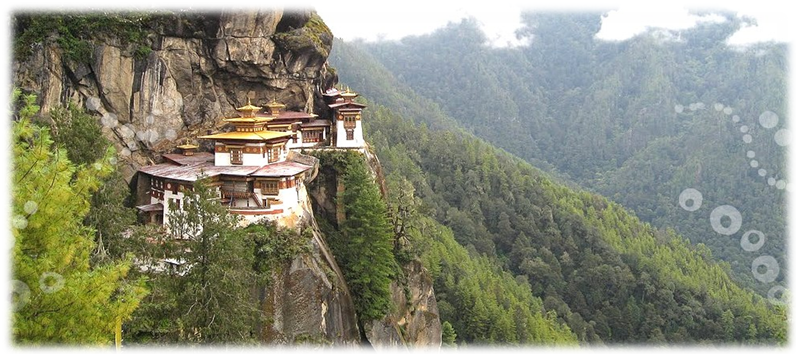
Morning Excursion to Taktsang Monastery & later visit Kyichu Lhakhang.Perched on the side of a vertical cliff at 3000 m altitude north of Paro, Taktsang monastery creates an impressive sight and is the unofficial symbol of Bhutan. It is one of the most famous Buddhist Monasteries in Bhutan and is also referred to as the ‘Tiger’s Nest’. Legend has it that Guru Rinpoche (Guru Padmasambhava) flew to this location from Khenpajong, Tibet on the back of a tigress and subdued a demon. He then meditated in a cave here for three months emerged in eight incarnated forms (manifestations) and blessed the place. Guru Padmasambhava is known for introducing Buddhism to Bhutan. Today, Paro Taktsang is the best-known of the thirteen caves in which he meditated. The first monastery was constructed in 1694, but in 1998 a tragic fire destroyed most of the original buildings - which have since been painstakingly restored to their former glory. Taktsang Monastery is a pilgrimage site for both tourists and locals, it is a journey filled with spiritual bliss. Keeping the spiritual side aside, the journey up to Taktsang Monastery is a Hiker’s delight. An hour's hike up to a small wooden teahouse called Cafeteria provides a close view of the monastery. A further and rather challenging hike leads you to the glorious Taktsang Monastery. After the hike, we will drive back to Paro. Later visit the Kyichu monastery. Located close to the Paro Airport, the Kyichu Lhakhang is an important Himalayan Buddhist Temple. Built-in the 7th century, this is one of Bhutan’s oldest religious sites in Bhutan. The temple is one of 108 built by Tibetan emperor SongtsenGampo to subdue a demoness who prevented the spread of Buddhism. Temples were built across the Himalayas to pin her body down. Kyichu Lhakhang pins down her left foot and Jamba Lhakhang in Bumthang her left knee. Guru Rimpoche visited this temple in the 8th century and concealed many spiritual treasures here. The fine statues of the Bodhisattvas and the Buddha in this temple are national treasures. The wooden floor of the sanctum is inlaid with turquoise and coral gemstones offered by pilgrims.
On time transferred to the airport to board flight or your home destination. --TOUR ENDS—